At a glance
- Choose a spacious, easy to access tray with an appropriate amount of absorbent litter.
- Keep fresh hay available at the toilet area and encourage voluntary use.
- Treat a sudden loss of habits or signs of discomfort as a potential health problem.
Set realistic expectations first
Lots of rabbits can be trained to urinate consistently into a tray (though a few dry droppings outside it may still be seen). Young rabbits, a new environment and territoriality can all make for rather unpredictable habits. Neutering can often help with the hormonal marking. It's worth discussing with your vet whether it's appropriate and when it should be done rather than just viewing the surgery as a quick fix for training.
Start by observing where the rabbit already chooses to do its business. Training is most effective when the tray is in line with that preference and the surroundings are secure. Never shout, never spray water, never rub a nose in an accident and never force the rabbit to stay in the tray. All of those things can make the area and the person frightening.
There's no such thing as a reliable one week promise. You need to track the pattern over several days whilst maintaining a normal care regime to be able to tell the difference between a sporadic pellet and a genuine accident. A rabbit that was previously reliable and then suddenly changes requires a completely different approach to a rabbit that's just arrived and is still getting to know the place.
Make the tray comfortable and easy to reach
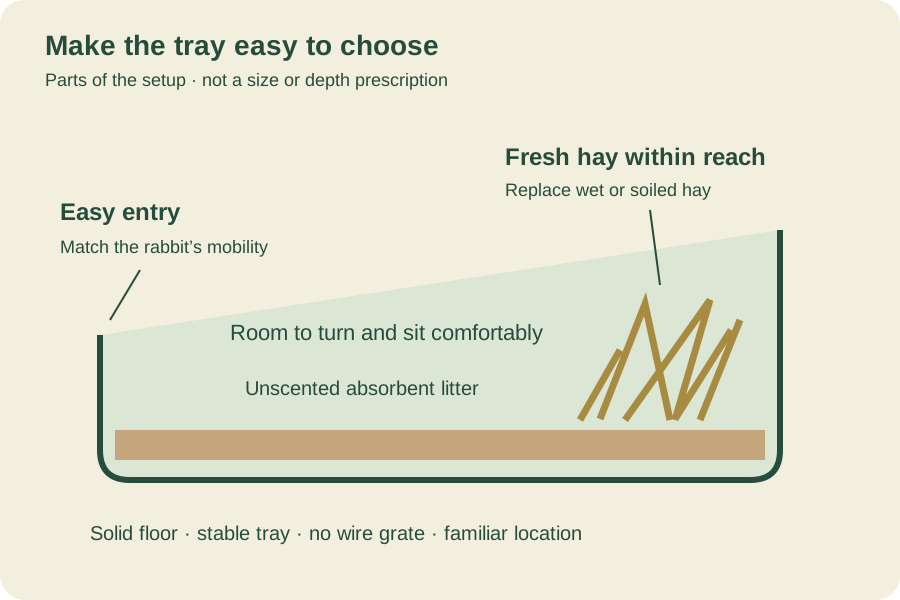
Choose a tray big enough for the rabbit to turn around in and sit comfortably without its back end dangling over the edge. A bonded pair may well require more than one tray and sufficient space to have a shared feeding area without being cramped. Check the actual fit rather than go on the basis of a small animal label.
Use a stable tray with a solid floor and an entry that the rabbit can negotiate. High sides will help contain the spray but an older or rather stiff rabbit may find a low entrance preferable. Don't use wire grates. Have fresh hay at one end of the tray or immediately adjacent to it so it can be easily accessed. Any hay that becomes wet or soiled should be removed.
Reference: Rabbit.org tray and hay guidance
Choose litter for absorbency and safe use
Use an unscented rabbit appropriate absorbent (paper based litter is ideal) and check the ingredients and instructions. The tray should be comfortable to stand on and easy to clean. Avoid clumping cat litter and anything that is dusty or strongly scented. 'Natural' on the packet doesn't tell you whether the animal is going to be able to use it or chew it.
Watch what your rabbit does with a new material. Repeatedly eating the litter, refusing the tray or showing signs of irritation all point to the need to look at the material again. Don't just cover a problem with a scented deodoriser. If you have a persistent chewer or one that's clearly uncomfortable then talk to your vet and change one thing at a time so you can work out what made the difference.
Part | Purpose |
|---|---|
Tray | Room to sit and turn, with a manageable entry. |
Absorbent litter | Collects urine; replace wet and soiled material. |
Fresh hay nearby | Encourages visiting the area while keeping food accessible. |
Cleaning kit | Makes prompt accident cleanup and regular tray washing easy. |
Reference: House Rabbit Network litter guidance
Teach the routine in a familiar home base
Put a tray in the corner the rabbit uses. If there are several regular corners then start with the extra trays rather than trying to overcome the preference.
Keep the living area well spaced out and safe with clear access to the hay, water and shelter. Don't confine the rabbit to a small cage as this would be a recipe for disaster.
Move a few dry droppings into the tray as a location cue. Remove any urine outside the tray as soon as possible. A cue is not a reason to leave the tray wet or dirty.
Note voluntary use. A quiet bit of praise or indeed a small portion of the normal food allowance can be used to reward it without making the training amount into an extra meal.
Keep the tray placement and general layout as predictable as possible whilst the habits are being developed. Record where the accidents occur and what has changed in the vicinity.
If the rabbit starts off using another corner then move a tray over there or add a tray temporarily. Don't be lifting it in and out of the box every few minutes. If it's getting fidgety when you come near then just step back and make it as easy as possible for it to make its own choice.
When you're cleaning, leave the layout as recognisable as possible. A spare tray is a godsend in that it makes it far easier to wash and dry one without having to remove every single familiar toilet spot. Just make sure both rabbits can still get to their hay and water whilst you're doing it.
Expand access one area at a time
Once use is reasonably consistent in the home base, open up a small additional rabbit proofed area whilst you can observe. Keep the route back to the tray very clear and add in another tray adjacent to a new toilet spot you've selected. Don't go and open up several rooms at once and then assume that the accidents are deliberate.
If accidents go up, go back to the last layout that was workable and ensure you have sufficient space. Look at where the problem is occurring exactly: is it right next to a door, on a very soft surface (a favourite one perhaps), or is it a long way from the original tray? That gives you something tangible to alter. Make one change, observe the result and don't go and change the litter, tray, floor and room layout all at once.
A useful record has four columns: date, accident location, recent change and action. "New room opened; urine in far corner; added accessible tray there" is an example of the sort of thing that would be recorded. It's a description of the situation, not an account of what was done with any motive such as spite or stubbornness.
Troubleshoot the pattern you actually see
What you notice | What to check | A reasonable next action |
|---|---|---|
Urine beside the tray | Entry height, stability, size and whether the rear hangs over. | Offer a roomier or easier-entry tray; seek advice if movement looks painful. |
One repeated corner | Whether the chosen location is far from the current tray. | Put a tray at that corner and keep the route clear. |
Scattered dry droppings | New territory, changes or hormonal marking. | Keep routines stable; discuss neutering and behavior if persistent. |
Accidents after access expands | Distance to the tray and unfamiliar rooms. | Add a nearby tray and expand access more gradually. |
Avoidance after cleaning or a new litter | Changed scent, texture, location or an uncomfortable surface. | Return to a suitable familiar arrangement and review one change at a time. |
Sudden decline in a trained rabbit | Pain, urinary problems, stiffness or other illness. | Contact a rabbit-experienced vet rather than simply restarting training. |
Straining, repeated attempts with little urine, blood, a wet or sore rear end, or apparent pain needs prompt veterinary advice. If reduced appetite or fewer droppings accompanies the change, call urgently. A troubleshooting table cannot diagnose a urinary or digestive problem.
Reference: Winter Park Veterinary Hospital litter-training guidance
Keep the toilet area clean without making it confusing
Remove any wet and soiled material and contaminated hay on a regular basis (at least once a day) and clean more frequently if required. Wash the tray with an appropriate cleaning product, adhere to the dilution and contact time instructions, rinse as directed, and dry before refilling. Never mix cleaning chemicals and keep the rabbits away from the cleaning area.
Clean the accidents thoroughly with a pet safe product appropriate to the surface and get the floor completely dry before the rabbits come back. Check under the mats and along the sides of the tray. A persistent odor is likely to be due to hidden urine or an inadequately absorbent litter rather than a requirement for perfume. If the rabbit is still sitting in wet material despite regular cleaning then you need to look at the size of the tray, the rabbit's mobility and the litter system.
A useful daily tray check
Can every rabbit get in and out comfortably?
Is the fresh hay clean and easily accessible?
Are wet patches and damaged material removed? Look for whitish spots if you have hardwood–they can turn dark and blackish if not dealt with quickly.
Is the tray stable and in its normal position?
Has the pattern changed, or is a rabbit showing discomfort?
Keep the wider care routine in mind. Eating, movement, comfort and health matter more than a spotless floor.
Common questions
Should I leave the tray dirty so my rabbit will get used to it?
A few dry droppings can help indicate the position during early training, but a rabbit should never stand in wet or heavily soiled litter. Keep the tray in a familiar location and clean it as needed.
Can an older rabbit learn to use a litter tray?
Yes. Make the entrance and route easy to manage and account for stiffness or other health issues. A sudden change in a previously reliable rabbit needs investigation rather than being dismissed as a training failure.
Sources & editorial notes
Revised October 21, 2026 using the references below. This is an editorial review, not independent veterinary approval. For advice about your animal, consult a qualified veterinarian.
- Rabbit.org — Litter training FAQ
- House Rabbit Network — Litterbox training
- RSPCA — Caring for an older rabbit
- PDSA — Reduced appetite in rabbits
- RSPCA — Rabbit behaviour and handling
- Winter Park Veterinary Hospital — Litter box training
What changed in this guide?
New litter-training guide with tray diagram, practical steps, cleaning routine, troubleshooting table and realistic expectations. Owner-reviewed Google Docs imported October 21; private prompts excluded; formatting damage and explicit safety wording repaired. Original snapshots retained.
Originally published . New guide created for the local site.
A little knowledge.
A more thoughtful home.