
At a glance
- Provide continuous usable space rather than just short exercise sessions.
- Use secure barriers and check anything that is within the reach of chewing or jumping.
- Put the shelter, the hay, the water and the litter all in places that the rabbits can comfortably reach.
Choose a room that works all day
Choose a space where you can control access, temperature, noise and the level of household traffic. A space which is perfectly comfortable for a short visit may well get too hot in the afternoon sun or become very busy when the kids get home. Look at the space in normal use before you commit to it. A conservatory, a doorway or an area next to a heater may be very difficult to get right.
Start with a room plan (doors, windows, outlets, furniture, heating and a route for cleaning). Mark where another pet could get in and where a rabbit could get out. Work out where the rabbits will be when you're asleep, when you're away and when you're opening the front door. The secure home base has to be a complete living environment, not just a small holding cage.
Reference: RSPCA guidance on indoor living
Measure the usable floor before adding furniture
RWAF recommend at least 3m x 2m of continuous floor area and 1m height for two average sized rabbits (approx 9ft 10in x 6ft 7in x 3ft 3in). Larger rabbits will require more space. This is an attributed welfare recommendation rather than a universal legal requirement. An upper shelf or a narrow corridor between cages does not count as a useful main floor.
Mark the footprint on the floor and then position the proposed trays and shelters within it. Ensure there are clear routes for running, turning, stretching and standing upright. If any of the furnishings are blocking the route then either expand the layout or reconfigure it. A pen's advertised dimensions may well be referring to the outside edges of the pen rather than the floor area actually available to the animals.
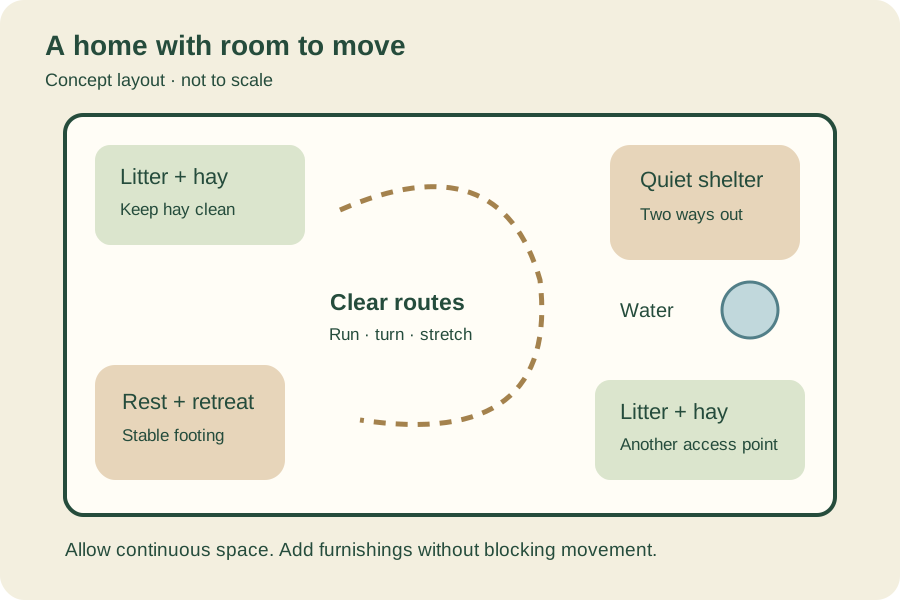
Reference: RWAF indoor space recommendation
Give each part of the home a useful job
Zone | Design goal | Check in use |
|---|---|---|
Rest and shelter | Quiet retreats with more than one way out. | Can a rabbit leave without passing a companion blocking the entrance? |
Hay and litter | Easy access to fresh hay near roomy trays. | Can both rabbits eat without crowding or sitting in wet material? |
Drinking | A stable, accessible supply away from heavy traffic. | Does water stay clean, and can every rabbit reach it? |
Movement | Uncluttered routes with grip. | Can the rabbits move freely rather than squeeze between objects? |
Human access | Reach every corner and remove trays easily. | Can you clean without dismantling the whole home? |
Do a pretend full clean before the rabbits arrive. Lift the tray, carry it through the gate, wipe the corner and replace it. This simple rehearsal often exposes problems that a pretty floor plan misses. Keep the carrier and cleaning kit accessible, with cleaning products stored out of reach.
For a bonded pair, having multiple resources means you're not so reliant on one access point. You need to watch how they actually use the home rather than just relying on a diagram to tell you everything. If you're repeatedly chasing them, if they're guarding or if the rabbit simply can't get at the food then you need to reassess and you need experienced advice.
Choose flooring for grip and maintenance
Test the route to food, water and litter as thoroughly as you would the resting area. Smooth surfaces can be very slippery and the rabbit will need good traction. A stable, washable surface or some form of suitable covering that is securely in place is required. Check the edges for signs of chewing. What is perfectly appropriate for one rabbit may be totally unsuitable for another that will be eating it.
Option | Useful feature | What to inspect |
|---|---|---|
Washable runners or mats | Grip and replaceable sections. | Sliding, loose threads, chewed edges and dampness underneath. |
Protected hard floor with grippy areas | Cleaning access and defined routes. | Bare slippery gaps, accessible joins and exposed backing. |
Existing carpet | Familiar footing. | Urine soaking through, pulled fibres and digging at corners. |
No covering is chew-proof. Remove material that is being swallowed and review the setup. Keep any absorbent pads or plastic liners inaccessible rather than leaving a tempting edge beside the litter tray. Check under mats when cleaning; a dry-looking top can conceal moisture. For an older or less mobile rabbit, discuss comfortable flooring and low-entry trays with the vet.
Reference: RSPCA advice for older rabbits
Rabbit-proof beyond the obvious cables
Start at floor level and look at every surface that is accessible from a box, a sofa or a platform. Moving a chair can create a new route to a windowsill. Supervision will help you to learn what the rabbits are going to investigate but it will not in any way replace physical protection (a cable can be damaged very quickly).
Hazard | Action to take |
|---|---|
Cables and outlets | Route cables completely out of reach or behind secure protection; inspect for damage. |
Behind appliances and furniture | Block access securely while maintaining appliance ventilation. |
Recliners and moving mechanisms | Exclude rabbits from the mechanism area; locate them before operating furniture. |
Plants, medicines and cleaning supplies | Remove from reachable surfaces and protect storage. |
Doors, stairs and outdoor exits | Use secure barriers and a household routine for opening doors. |
Fabric, small objects and loose fittings | Remove loose threads, small swallowable pieces and exposed fasteners. |
Do not assume a thin cable sleeve, cardboard barrier or bitter spray will withstand chewing. Inspect the actual barrier regularly. Check where a determined rabbit could push underneath, squeeze through, climb over or become trapped. Keep gates secure and choose openings appropriate to the animals’ size; a child gate is not automatically a rabbit-safe gate.
Reference: Rabbit.org rabbit-proofing guidance
Offer enrichment without filling every gap
Give the rabbits choice of a sheltered rest, a safe place to chew, a foraging opportunity and space to move. That's the RSPCA guidance on enrichment (it should enable natural activity rather than inhibit it). Leave an open route around any new furnishings and secure anything that could fall.
Introduce one change at a time so you can see the effect. For instance, move that familiar cardboard tunnel a bit rather than going through and replacing every shelter in a full clean. Check all the damaged materials and get rid of anything that's unsafe. Avoid any high platforms with unprotected falls, any narrow openings and any decorations which would make the enclosure more difficult to inspect.
Photograph the finished layout from above and from rabbit height for your own record of what you've done. After you've moved a shelf, added a hide or reconfigured the room, go back and recheck the routes. The useful question is whether the rabbits can move, retreat and get to the essentials.
Reference: RSPCA enrichment principles
Check the home before leaving rabbits unsupervised
The final walkthrough
Gate closed: the full living space remains available. This depends on rabbit and room setup
All cables, plants, medicines and cleaning products are out of reach. Non-negotiable, they will chew anything they can get their teeth into.
There's no route behind an appliance or into a moving mechanism. Another key point is that they'll squeeze into spaces you'd never have thought was possible.
Flooring stays in place and has no loose lining that's accessible. Check rugs, backing and carpet for loose or chewed material.
Trays, hay and water are all within reach. There is no narrow doorway to restrict access.
Shelters are stable and you can inspect them without having to chase an animal.
The room is suitable all day. Just need to manage the direct sun and heat sources.
Everyone knows where the rabbits are prior to opening any doors or moving any furniture.
Look at the home's initial uses and sort out any problems before you go and rely on it overnight. Recheck after cleaning and every time you move furniture. If you subsequently open up more rooms, secure each one in turn and keep the home base as you know it. More freedom shouldn't equate to losing access to the tray, the water or a safe place to retreat to. Rabbits are very much inclined to hide and to be in or under things.
Keep on with the litter training and the daily care routine. If you're looking at a genuinely outdoor home then use the separate outdoor housing guide. Indoor barriers will not offer any protection from outdoor predators or the elements.
Common questions
Can I start off in a small cage until litter training is complete?
Don't make adequate space contingent on perfect litter box habits. Use a secure appropriately sized home base, add trays as required and then slowly expand access to other rabbit-proofed areas.
Is a free-roaming rabbit automatically going to get a better setup?
Only if the accessible area is safe and will support rest, movement, food, water and litter access. A well thought out secure room is far more useful than nominal freedom around unprotected household hazards.
Sources & editorial notes
Revised October 21, 2026 using the references below. This is an editorial review, not independent veterinary approval. For advice about your animal, consult a qualified veterinarian.
- RWAF — Indoor rabbit housing
- Rabbit.org — Bunny proofing your space
- Rabbit.org — Indoor and outdoor hazards
- RSPCA — Keeping rabbits indoors
- RSPCA — Rabbit enrichment
- RSPCA — Caring for an older rabbit
What changed in this guide?
New indoor housing guide with an original layout diagram, hazard checks, floor decisions and a practical pre-arrival walkthrough. Owner-reviewed Google Docs imported October 21; private prompts excluded; formatting damage and explicit safety wording repaired. Original snapshots retained.
Originally published . New guide created for the local site.
A little knowledge.
A more thoughtful home.